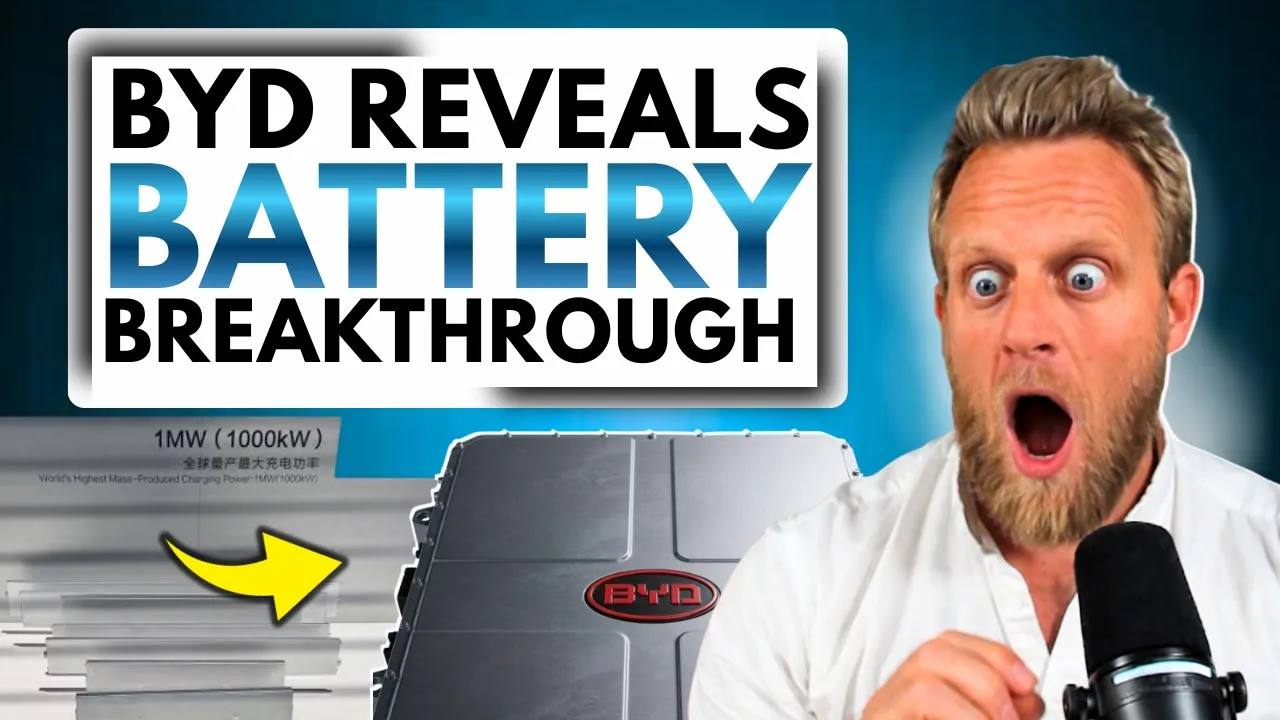
BYD's 10,000-Cycle Battery Bombshell: Solid-State & Sodium Are Here to Reshape Everything!
🚀 Insight
BYD, the undisputed titan in both electric vehicles and battery manufacturing, has just dropped a monumental announcement that could fundamentally redefine the future of electric mobility and grid-scale energy storage. The Chinese powerhouse claims significant breakthroughs in both solid-state and sodium-ion battery technologies, touting an astonishing 10,000 charge cycles. This isn't just an incremental improvement; it's a quantum leap promising vastly improved safety, dramatically lower costs, and longevity that could make an EV outlast its owner. This strategic move doesn't just solidify China's, and specifically BYD's, position at the forefront of the global battery race – it reconfigures the starting line for everyone else.
⚙️ Deep Dive
- Solid-State Battery Advancements: BYD's progress in solid-state chemistry suggests they've overcome major hurdles in manufacturing scalability and stability. By replacing flammable liquid electrolytes with solid materials, these batteries promise superior energy density (leading to extended range), significantly enhanced safety (eliminating thermal runaway risks), and potentially ultra-fast charging capabilities. While often considered a distant, futuristic tech, BYD's announcement signals a tangible path towards mass production, potentially powering EVs as early as 2027, according to industry reports.
- Sodium-Ion Battery Innovation: Often positioned as a lower-cost alternative to lithium-ion, BYD's sodium-ion technology achieving a 10,000-cycle life is truly groundbreaking. Sodium, being far more abundant and cheaper than lithium, makes these batteries ideal for cost-sensitive applications like stationary grid storage, entry-level EVs, and urban mobility solutions. This unprecedented cycle count unlocks incredible durability, making them perfect for heavy-duty, repeated charging scenarios without significant degradation.
- The Power of 10,000 Cycles: To put this in perspective, most modern EV batteries typically offer around 1,000 to 3,000 cycles before experiencing significant capacity degradation. A 10,000-cycle battery means an EV could theoretically be charged and discharged daily for nearly 30 years without losing substantial performance. This dramatically extends vehicle lifespan, increases residual value, and makes second-life applications for grid storage almost a certainty, maximizing resource utility and minimizing waste.
- Unprecedented Safety & Cost Efficiency: This dual-pronged approach directly addresses the two primary concerns hindering broader battery adoption: safety incidents and high acquisition costs. Solid-state's inherent safety eliminates fire risks associated with liquid electrolytes, while sodium-ion's reliance on abundant raw materials inherently drives down costs. This combination offers robust, affordable, and safer energy solutions across the entire ecosystem, from premium performance EVs to large-scale renewable energy integration.
- Geopolitical and Market Implications: As the world's largest EV manufacturer and a dominant battery producer, BYD's mastery of these next-gen chemistries further cements China's leadership in the global energy transition. This breakthrough puts immense pressure on established Western automakers and battery developers to accelerate their own R&D, potentially reshaping global supply chains, competitive landscapes, and the very definition of energy independence.
💡 Verdict
BYD's twin battery breakthroughs are nothing short of revolutionary. The prospect of electric vehicles lasting for decades with significantly enhanced safety and at a dramatically lower total cost of ownership fundamentally alters the value proposition of electric mobility for consumers and fleet operators alike. Beyond vehicles, these innovations offer a critical pillar for robust, affordable, and sustainable grid energy storage, accelerating the global transition to renewable power sources. We're not just talking about better batteries; we're talking about a paradigm shift that promises to democratize electric transport and enable true energy independence on an unprecedented scale. The future of power just got a massive, 10,000-cycle upgrade, and BYD is undoubtedly leading the charge. This isn't just trending tech; it's the future of energy arriving faster than anyone predicted.
Source: BYD Reveals Solid State and Sodium Battery Breakthrough - 10,000 Cycles!


