🚀 Insight
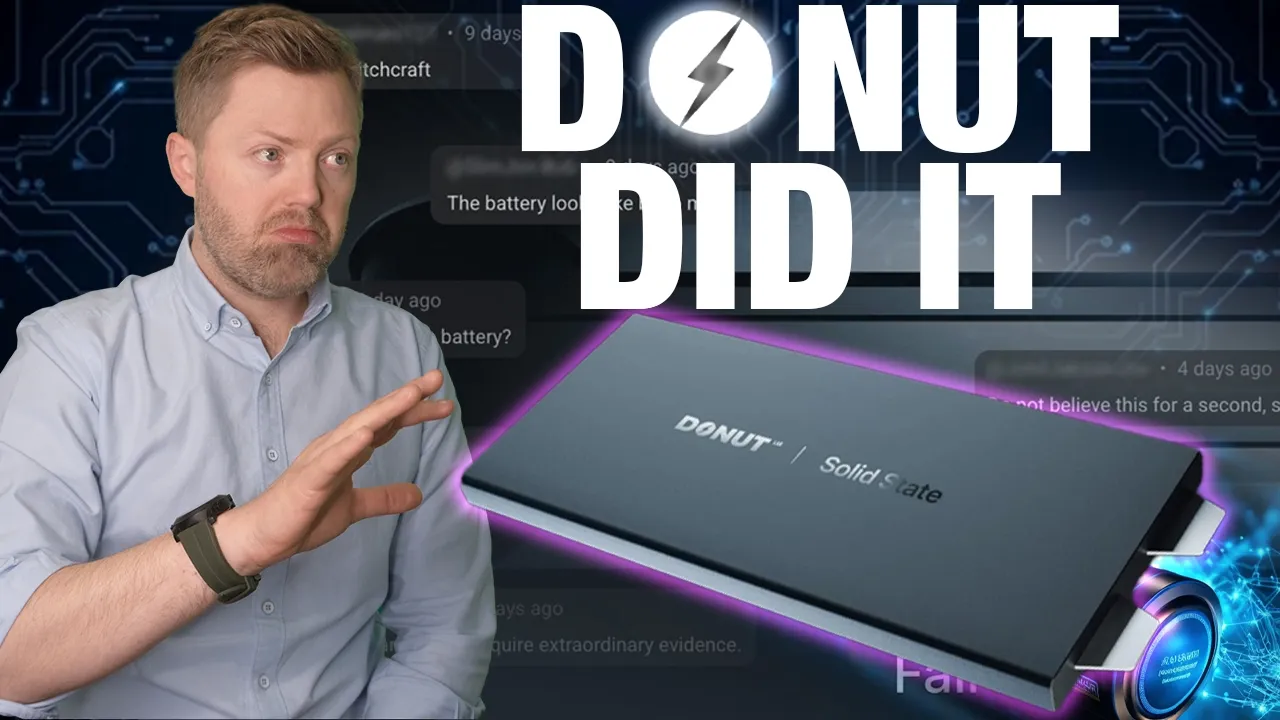
The "Holy Grail" of electric vehicles has always been the 5-minute refill—matching the convenience of internal combustion engines. Donut Lab’s solid-state battery claims have recently moved from "miracle" hype to documented data, following independent testing by the VTT Technical Research Centre of Finland. The headline is staggering: a prototype cell successfully charged from 0% to 80% in under five minutes. While the results validate the physics of ultra-fast solid-state charging, they also highlight the massive engineering bridge that still needs to be built before this technology hits the driveway of a consumer EV.
⚙️ Deep Dive
The VTT report provides a rare, transparent look at the performance of solid-state chemistry under extreme stress. Here is the technical breakdown of the test results:
- Extreme 11C Charging Rate: To achieve an 80% charge in under 5 minutes, the cell was subjected to an 11C rate. For context, most current high-end EV cells operate at 1C to 3C. This represents a massive leap in current throughput without immediate cell failure.
- Thermal Resilience: During the test, the cell reached temperatures of 89°C (192.2°F) with limited cooling. In a traditional lithium-ion battery, these temperatures would approach the zone of thermal runaway; however, the solid-state architecture remained stable.
- Capacity Retention: Perhaps the most impressive stat was that after this extreme fast-charging event, the cell retained 98% to 99.6% of its discharge capacity. This suggests the high-heat, high-amperage surge didn't immediately "brick" the chemistry.
- The Scaling Challenge: The test was performed on a single 94Wh prototype cell. An average Tesla Model 3 contains thousands of cells totaling ~75,000Wh. Managing the heat and power distribution across a full pack at an 11C rate is a significantly more complex thermal management challenge.
- The Unknowns: The report does not cover cycle life (how many times can it do this before degrading?), energy density (is it too heavy?), or manufacturing costs.
💡 Verdict
The VTT test results are a massive win for Donut Lab because they silence the "vaporware" accusations with hard, independent data. We now have proof that 5-minute charging is no longer a theoretical "maybe"—it is a physical "yes." However, as a Senior Analyst, I advise cautious optimism. The jump from a single 94Wh laboratory cell to a 100kWh automotive-grade battery pack involves solving massive hurdles in manufacturing consistency and cost-efficiency. This is a breakthrough in capability, but we are still waiting on the breakthrough in scalability. If Donut Lab can prove these cells survive 1,000+ cycles at these rates, the ICE age is officially over.
Source: Donut Lab’s Solid-State Battery Tested — Here’s What It Actually Proves
🛠️ Dive Deeper into the Engineering Core
👉 Click here to read the full technical breakdown on our Community Forum!


