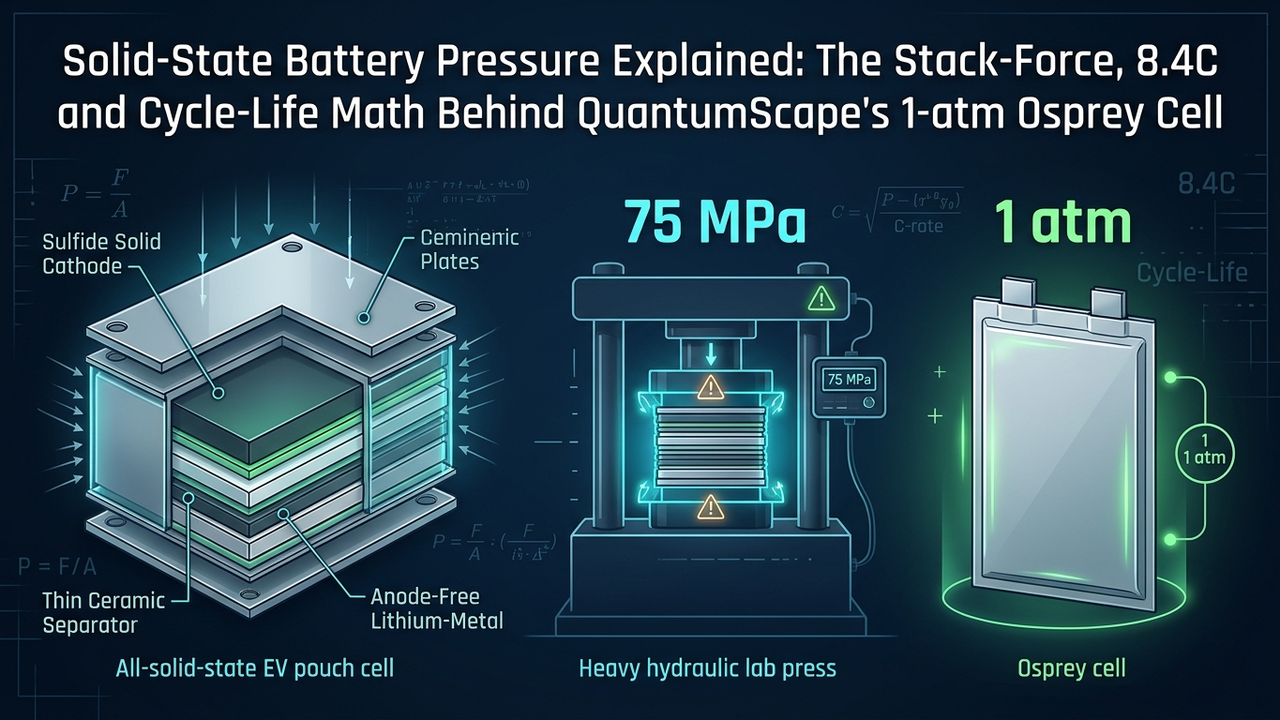
Most sulfide solid-state battery papers test their cells inside a press. A common lab setting is 75 MPa, which is about 740 times atmospheric pressure. On November 11, QuantumScape said its new Osprey cell ran 1,000 cycles at just one atmosphere. If that holds up, it attacks the least glamorous problem in solid-state batteries: the clamp.
QuantumScape calls Osprey an "open platform." It pairs the company's ceramic separator and anode-free lithium-metal design with an all-solid sulfide cathode. Its early-test claims: 1,000 full cycles at about 80% capacity retention, 10–80% charge in five minutes, one atmosphere of pressure, operation below −20 °C, and projected energy density up to ~1,100 Wh/L. These are company figures from early testing, not results from automotive-format cells. Below are four pieces of math that show what each number means for engineers.
1. Solid-State Battery Stack Pressure: Why Force Scales With Area
A liquid electrolyte wets every surface. A solid electrolyte can't do that. Particles touch only at contact points, and those contacts open up when the electrodes swell and shrink. Labs fix this by squeezing the cell. A 2025 review on low-pressure ASSBs puts typical lab operating pressure at 50–600 MPa. It says OEMs will accept no more than about 2 MPa. A recent Nature Communications paper cycled its cells at 75 MPa and called 10 MPa "low stack pressure."
Lab pellet: 75 MPa × 1 cm² (1×10⁻⁴ m²) = 7.5 kN (~0.77 tonne-force)
Same 75 MPa on a 0.1 m² pouch face* = 7.5 MN (~765 tonne-force)
OEM target 2 MPa × 0.1 m² = 200 kN (~20 tonne-force)
*0.1 m² is an illustrative large-format cell area, not an Osprey spec.
A hydraulic press can hold a 1 cm² pellet. A car-sized cell is a different problem. Stacked cells are in series mechanically, so the end plates carry the full P × A force no matter how many cells sit between them. Even at the 2 MPa OEM limit, every module needs end plates and tie rods rated for about 20 tonnes. Those plates must also stay flat, because uneven pressure means uneven lithium flux. "One atmosphere" means no added clamp at all, just ambient air on both sides.
2. Anode-Free Lithium Metal: The Breathing-Thickness Formula
An anode-free cell starts with no lithium on the anode side. Every charge plates a fresh lithium layer onto the current collector, and every discharge strips it away. That layer's thickness depends only on areal capacity.
tLi = Qareal / 2,061
Example 4 mAh/cm² → tLi ≈ 19.4 µm per layer, every cycle
20 layers in a cell → ~0.39 mm of "breathing" per charge
This swing is why pressure matters. With a liquid electrolyte, the gap just refills. In a solid stack, the separator has to stay in contact with a lithium surface that rises and falls by about 20 µm, and with a cathode that swells too. Lose contact and current crowds into the remaining spots, which drives dendrites. Running at 1 atm means the cell's internal design, not a steel clamp, must keep those contacts closed. QuantumScape credits its ceramic separator for this. The release does not explain the mechanism.
3. Five-Minute Charging: The C-Rate and Charger-Current Math
The "10–80% in five minutes" claim turns into a C-rate like this:
Example 75 kWh pack: 52.5 kWh in 5 min → Pavg = 630 kW
I = P / V → 800 V pack: ~788 A · 400 V pack: ~1,575 A
Heat ∝ I²R → 8.4C vs 2C at the same R: (8.4/2)² ≈ 17.6× the joule heat
The cell may handle 8.4C, but the car still has to get 630 kW in. At 800 V that is close to 800 A on average, which is past what most passenger-car DC chargers deliver today. It is closer to the 1,000 A Megawatt Charging System built for trucks. At 400 V you would need about 1,575 A. The I² term also means pack busbars, contactors and cooling must remove roughly 17× the heat of a 2C session for the same resistance. The cell result is a necessary step. Making the vehicle, cable and charger match it is a separate job.
4. Cycle Life and 1,100 Wh/L: What the Numbers Buy an EV
Example: 75 kWh × 6 km/kWh = 450 km per full cycle
Average capacity over life ≈ 90% → 1,000 × 405 km ≈ ~405,000 km
Cell volume for 75 kWh: 75,000 Wh / 1,100 Wh/L ≈ 68 L vs 107 L at 700 Wh/L*
*700 Wh/L is an illustrative comparison point for today's cells, to verify per chemistry.
A thousand full cycles is enough lifetime for a passenger EV, because most drivers rarely use a full 100% cycle. The volume number matters even more. Cutting the cell volume of a 75 kWh pack by about 40 liters frees space for a lower floor, a smaller pack, or more range in the same footprint. The catch: QuantumScape calls 1,100 Wh/L a "projected" figure, and the release does not say whether the 1,000 cycles were run at the five-minute charge rate.
- Osprey cell format, capacity and test temperature. QuantumScape points to a white paper for test conditions, and we have not reviewed its details here.
- Whether the 1,000-cycle and 5-minute results come from the same test protocol.
- ~1,100 Wh/L is projected, not measured in a commercial-format cell.
- The 0.1 m² cell area, 4 mAh/cm², 75 kWh pack, 6 km/kWh and 700 Wh/L values are our illustrative assumptions, not supplier specs.
The Engineering Takeaway on Solid-State Battery Pressure
- Pressure scales with area. 75 MPa is easy on a 1 cm² pellet and impossible on a car cell. Even the 2 MPa OEM limit means about 20 tonnes per module face.
- Anode-free cells breathe. About 20 µm of lithium per layer comes and goes every cycle, and contact has to survive that without a clamp.
- 8.4C is a system problem. On an example 75 kWh pack, a five-minute 10–80% charge needs about 630 kW and roughly 800 A at 800 V.
- Read the fine print. These are early-test, company-reported numbers. Others are still at the pilot stage: Gotion reports 90% yield on a 0.2 GWh pilot line, and CATL has moved to 20 Ah sulfide cells with small-batch production targeted for 2027.
"Solid-state" doesn't automatically mean "can't catch fire." We dig into the hidden failure modes in Who Says Solid-State Batteries Won't Catch Fire? on our YouTube channel. For how temperature limits fast charging in today's cells, see EV Winter Range Loss Explained.
Sources: QuantumScape Osprey press release (Nov 11, 2026); Challenges and Strategies of Low-Pressure All-Solid-State Batteries (review); Nature Communications, Li–S all-solid-state positive electrode; Joule, Scaling up sulfidic solid-state batteries; EnergyTrend on Gotion; Electrek on CATL. Calculations by The Engineering Core using the illustrative assumptions stated above.


