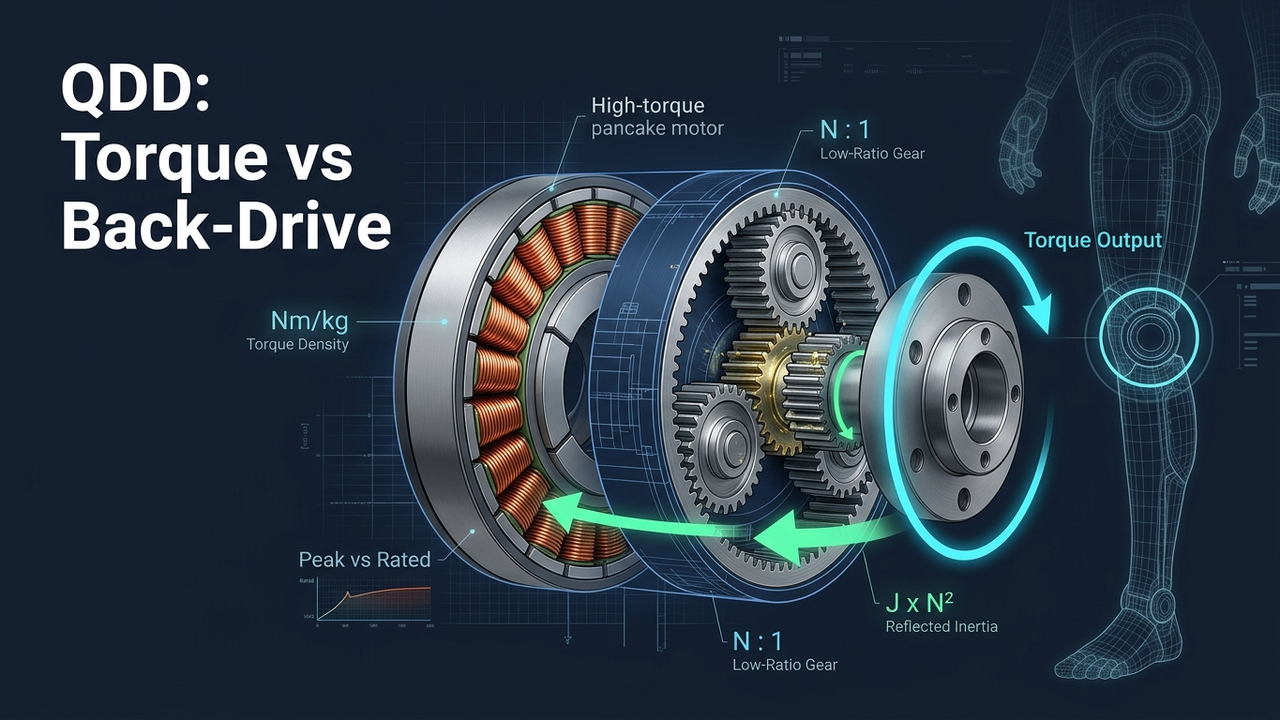
Bottom line first: A humanoid knee has to do two opposite jobs. It must hold the robot's weight, and it must give way when a foot lands on uneven ground. A quasi-direct-drive (QDD) actuator handles both by using a big motor and only a small gear reduction. In November 2026, KNR Systems showed a 1.76 kg QDD with 121 Nm rated and 308 Nm peak torque. NSK added a QDD to its humanoid range. Hyundai Mobis started building prototype actuators for Boston Dynamics' Atlas. This article works through the four numbers that decide whether a joint actuator works: torque density, reflected inertia, peak-torque heating and fleet scale.
What happened: a month of humanoid actuator launches
- KNR Systems (Nov 4): a high-torque QDD for hip, knee and ankle joints. It uses a compound planetary gear with what the company calls bidirectional drive gear technology. KNR says the reduction ratio is 2–4× or more higher than conventional QDDs while the joint stays back-drivable. The unit is 110 mm × 83 mm, weighs 1.76 kg, and is rated at 121 Nm continuous / 308 Nm peak (Edaily).
- NSK (Nov 26): small and large rotary and linear actuators added to last year's mid-size range, plus a new QDD rotary actuator with a low-ratio planetary gear. It is aimed at wrists, elbows and quadruped legs. NSK will show it at RoboNext 2026 in Osaka (Dec 2–4), with samples to follow and market launch targeted by FY2027 (NSK, Japanese).
- Sesame Motor (Nov 20): integrated motor, planetary gearbox and encoder joint modules. The PJM90T is rated 108–170 Nm at 2.3 kg, and the PJMD70 is rated 28–40 Nm at 0.85 kg, depending on reduction ratio (Sesame Motor).
- Hyundai Mobis (Nov 11): prototype Atlas joint actuators built in Uiwang this month, with full-scale supply targeted for 2028 (UPI / Asia Today).
1. QDD actuator torque density: Nm per kilogram is the first filter
Every kilogram in a leg joint has to be carried, swung and decelerated on every step. So the first figure to check is torque per unit mass:
Torque density = τ / m (Nm/kg)
- KNR QDD: 121 / 1.76 = 68.8 Nm/kg rated, and 308 / 1.76 = 175 Nm/kg peak
- Sesame PJM90T: 108–170 / 2.3 = 47–74 Nm/kg rated
- Sesame PJMD70: 28–40 / 0.85 = 33–47 Nm/kg rated
Volume matters too, because a hip joint has to fit inside a thigh. The KNR housing is π × (0.055 m)² × 0.083 m ≈ 0.79 L. That gives about 153 Nm/L rated and 390 Nm/L peak. These numbers are a fair way to compare actuators only if every vendor defines "rated" the same way. Section 3 shows why that is not guaranteed.
2. Gear ratio and reflected inertia: why QDD stays at a low ratio
A gear multiplies torque linearly, but it multiplies the motor's inertia by the square of the ratio:
τout = N × η × τmotor
Jreflected = N² × Jrotor
τback-drive ≈ N × τfriction+cogging / ηback
When the foot hits the ground, the joint sees the motor rotor through that N² term. A harmonic drive at 100:1 makes the rotor feel 10,000 times heavier at the output. That is why such joints are stiff, hard to back-drive, and need a torque sensor to feel contact. A QDD uses a low ratio, so the motor current itself is a usable torque signal (τ ≈ Kt × I × N).
What KNR's "2–4× higher ratio" means (illustrative): if a conventional QDD runs at N and a new design runs at 3N, the same motor gives 3× the output torque. But reflected inertia rises 9×, and back-drive friction about 3×. The motor can shrink for the same torque, which helps, because a smaller rotor has much lower Jrotor. Whether the joint still feels "transparent" depends on that trade-off and on gear efficiency in reverse. KNR says its gear design keeps back-drivability, but it did not publish a back-drive torque figure (to verify).
3. Peak vs rated torque: the I²R math that limits a jumping robot
Motor torque is roughly proportional to current, but copper loss is proportional to current squared:
τ ≈ Kt × I → PCu = I² × R ∝ τ²
KNR's peak-to-rated ratio is 308 / 121 = 2.55×. At peak torque, copper loss is about 2.55² ≈ 6.5× the rated level. This assumes Kt stays constant; magnetic saturation at peak current makes the real figure worse. So peak torque is a time budget, not a steady state.
If "rated" means the continuous thermal limit, a walking or jumping gait has to pass an RMS torque check:
τRMS = √( Σ τi² × ti / T ) ≤ τrated
- Peak bursts with zero torque between them: duty ≤ (121 / 308)² = 15.4%
- Peak bursts with a 60 Nm holding torque between them: d × 308² + (1 − d) × 60² ≤ 121² → d ≤ 12.1%
A knee that holds body weight never really rests, so the holding torque eats into the peak budget. This is the same trade-off as EV motors, where gearing and thermal limits set what the drivetrain can sustain. Our video The Torque Trap: Why EVs Refuse to Shift Gears covers the gearing side.
4. Humanoid robot actuator scale: 30 joints per robot
According to industry estimates cited by UPI, each Atlas needs about 30 actuators, at an assumed mass-production price of $800–1,100 each. Hyundai Motor Group plans capacity for 30,000 Atlas robots a year by 2028 and 350,000 actuators a year in the US (UPI).
30 × $800–1,100 = $24,000–33,000 per robot
30,000 robots × 30 = 900,000 actuators/year
350,000 / 900,000 ≈ 39% of that demand
UPI's own per-robot figure is 35–50 million won (about $26,000–37,200), slightly above the simple product. The capacity gap may be covered by other plants or suppliers, but the article does not say (to verify). Mass matters as well. If all 30 joints used a 1.76 kg unit, the actuators alone would weigh 52.8 kg. That is why NSK sells small, mid and large sizes matched to wrist, knee and hip loads instead of one universal joint.
- KNR did not publish its actual reduction ratio, back-drive torque or how long the 308 Nm peak can be held. The "3N" example above is illustrative.
- The 60 Nm holding torque and the RMS duty results are worked examples, not KNR test data. They assume rated torque is the continuous thermal limit and Kt is constant.
- The 30-actuator count and the $800–1,100 price are industry estimates reported by UPI, not Hyundai or Boston Dynamics specifications.
- NSK has not released torque or mass figures for its new QDD in the announcement.
What to take away: how to read a robot actuator spec sheet
- Compare Nm/kg at the same definition: check whether "rated" is continuous and at what ambient and housing temperature.
- Ask for the gear ratio and back-drive torque: a higher ratio raises reflected inertia by N², so torque density alone does not describe the joint.
- Run an RMS check on the real gait: peak torque divided by rated torque, squared, sets the duty-cycle limit.
- Watch cost and capacity, not just demos: at 30 joints per robot, actuators are a large part of the cost of a humanoid robot.
For the motor side of the story, see our video EV Motors Explained: PMSM vs Induction.
Sources: Edaily, Nov 4, 2026 · NSK, Nov 26, 2026 · Sesame Motor, Nov 20, 2026 · UPI / Asia Today, Nov 11, 2026


